
Celebrating International Womens Day, Friday 8 March 2024
Olive Constable defied the norms of her era to become a successful journalist, editor and businesswoman. Her reportage leaves an enduring legacy which we still enjoy today, over 100 years later.
Olive Estelle Henrietta Constable served as editor of the Moruya Examiner for over a quarter of a century, from 1913 until her death in 1939. Like many women of her time, we don’t know much about Olive or what motivated her. However, she undoubtedly required exceptional determination to thrive during an era when women were anticipated to assume subordinate positions.
Newspaper editor at 37 years of age
Born in 1876, Olive assumed the mantle of editorship at the age of 37, just a year after her marriage to Arthur Constable. It was a role she inherited from her father, Robert Henry Harvison, who had acquired the paper in 1877.
Country newspapers were family businesses and it was not unusual for women to be involved to some degree, though rarely as editors and managers. Olive had 2 sisters and a brother, perhaps she was the only one with an interest in the newspaper business.
Harvison was known for airing his strong opinions in the paper, at one point he was sued for defamation. Under Olive the paper moved to factual reporting and generally a more sympathetic style. This doubtless reflected her character, but perhaps it was also what the times – and the community – demanded.
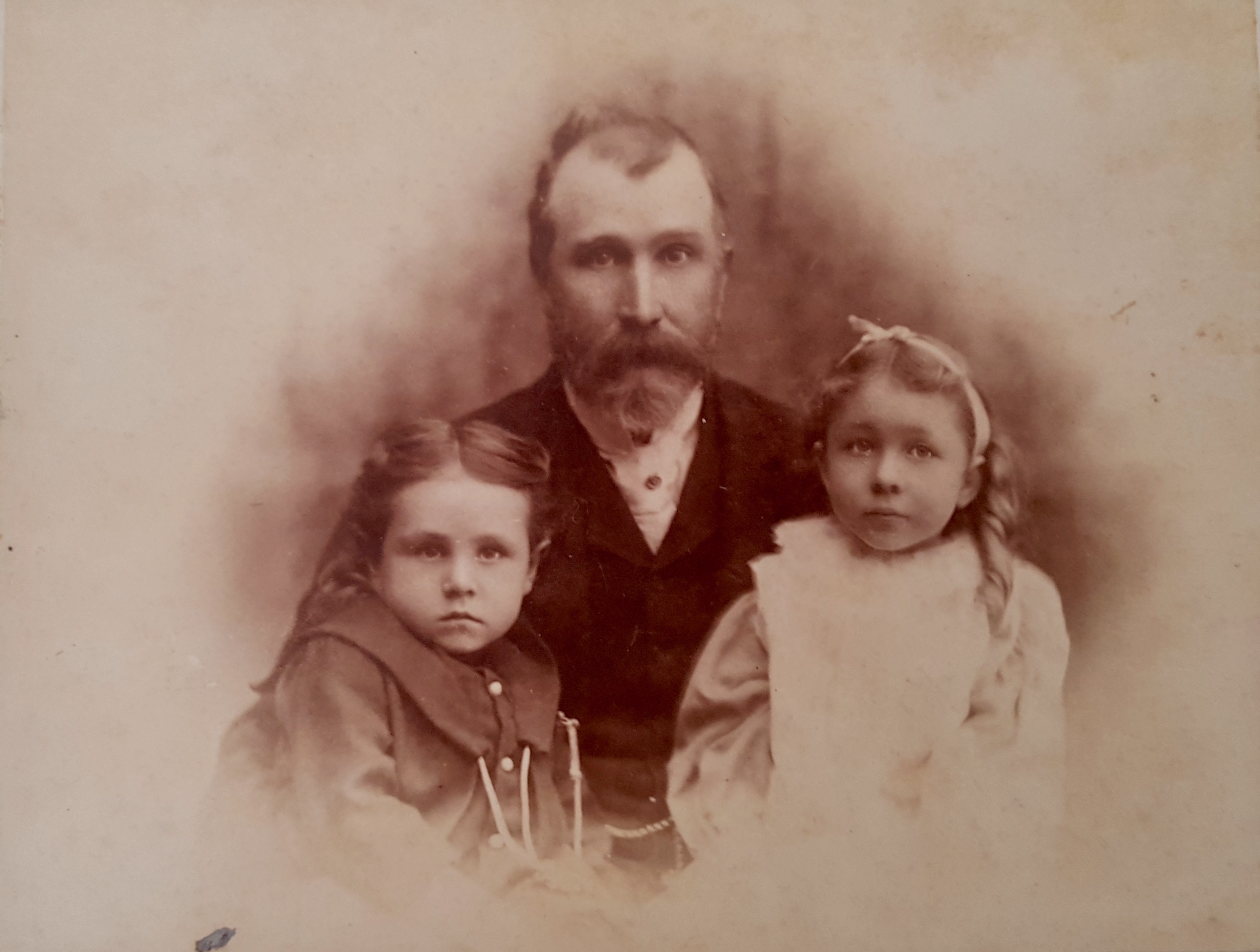


Digital collage from old photos

Signed by OEH Constable in June 1924
An historic record of a tumultuous era
Her tenure as editor coincided with tumultuous times – the upheaval of World War I, the devastating Great Influenza pandemic, the roaring twenties and burgeoning tourism industry, the economic turmoil of the Great Depression, and the ominous shadows cast by the looming Second World War.
In the midst of these historic events, the Moruya Examiner emerged as a faithful chronicler of community life, documenting everything from dances and euchre drives, local politics and international events, details of cattle sales and sailing times, and news of fire and flood.
It remains as an outstanding historical record of how lives were lived during a fascinating era of Moruya’s development.
Living and working in Campbell St
Olive lived with her husband Arthur Constable at 56 Campbell St, right next door to the newspaper office. Perhaps it is no accident that Harvison commissioned the editor’s house and newspaper printing office in 1913, the year Olive assumed editorial control. Of unusual granite construction, these heritage-listed buildings are featured in the Moruya Heritage Walk.
Arthur Constable had worked for Harvison in the printing room, and also handled advertising for the paper. But ultimately it appears he spent most of his time caring for Harvison’s race-horses.
We can assume he had little interest in editorial matters as he sold the paper shortly after Olive’s death.
Olive’s death just a few days after her 63rd birthday was unexpected:
Seldom have the people of this district received such a shock as when on Tuesday last Mrs Constable, Editoress and Proprieter of this paper, passed away. On Friday last week Mrs Constable completed the issue of the ‘Examiner’in apparent good health and spirits, except perhaps for a little tiredness, inseparable from the closing day of the usual strenous week. She was persuaded to rest. The ensuing two days saw her condition worsen and on Monday morning Mrs Constable was taken to the hospital, her case being diagnosed as pneumonia.The trouble developed alarmingly and on Tuesday afternoon, she passed peacefully away. Mrs Constable’s activities in the community, apart from her editorial duties, themselves exacting and continuous and arduous, were widespread. Hospital Auxiliary, Hospital Board, Red Cross, CWA, Surf Club, all had her active support. Church life and efforts in aid of charity also had in her a faithful and willing worker. Her death leaves a gap in the life of the community which indeed it will be hard to fill. . . The attendance at the funeral was large and impressive and evidence of the widespread respect in which deceased was held in the community.
Obituary – Moruya Examiner, 28 January 1939
Official records list Olive’s occupation as “home duties” – small recognition of over 25 years of professional journalism.
But her peers knew better:
“The removal of Mrs Constable will mean a distinct loss to country journalism and her passing is keenly felt by the newspaper fraternity. As Editoress of the Examiner she set a high standard in her publications, displaying at all times a kindly feeling towards her fellow creatures. She was a most lovable woman and her home was hospitality itself to her many friends. . . Apart from her editorial duties, deceased always kept her business books up to date and had a thorough grasp of modern business methods.”
Editor of the Cobargo Chronicle on the passing of Olive Constable
Some extracts from the Moruya Examiner during Olive’s editorship
As was expected, the ‘flu epidemic has broken loose, and is travelling like wildfire throughout country towns as well as in the big centres of population such as Sydney. We are pleased to say, however, that so far there is no necessity for our people to lose their heads or become funky as Moruya, as far as we know, has not yet had any cases of an alarming nature, the local outbreak being influenza of the common or garden variety.
Moruya Examiner, 28 June 1919
During the past few months rumours have been in circulation that it had been decided to obtain the granite from Moruya for the North Shore bridge approaches, and that from 500 to 700 men would commence work this month at Pompey Point Quarry. … The Under-Secretary stated that the decision rests entirely with the successful tenderer as to whether this quarry will be made use of.
Moruya Examiner, 12 January 1924
The wreck of the steamer Bodalla at Narooma on Saturday night created some excitement in Moruya on Sunday morning, and in a short time car after car of sightseers were seen bowling along the road to the scene. … When entering the port at Narooma at 7.45 p.m., the vessel struck the bar and was carried by the southerly current and north-east wind on to the rocks, where her keel was broken . . .
Moruya Examiner, 8 March 1924
Read more
- Moruya’s Newspapers and the people who ran them by Wendy Simes – Part 1, MDHS Journal December 2019
- 16 Women of Early Eurobodalla by Noel Warry – MDHS
- Business Women of Moruya – by N. Behringer, D. Blessington, J. Byrne, D. Cowley, J. Love & W. Simes. MDHS
- Moruya Pioneers Directory – An Index of the District Inhabitants to 1900, Vol 1. MDHS 2018
- News from100 Years Ago – Extracts of the Moruya Examiner from 1898 to 100 years ago
- Bold Types – How Australia’s First Women Journalists Blazed a Trail, Patricia Clarke, National Library of Australia 2022
More posts on Women in Eurobodalla
A Woman’s Lot
Special Exhibition – providing a captivating peek into the lives…

Persia Campbell – a long way from Nerrigundah
Professor Emelita Persia Campbell was born at Nerrigundah on 15th…
Women in Portrait
Museum Exhibition: 8 March – 6 April 2019 This exhibition…
Mrs Bridget Johnston: An Exceptional Teacher in Eurobodalla
Mrs Bridget Johnston was a truly amazing woman, the only…


 MORUYA and District Historical Society Blog
Leave a Reply